June 23, 2026 · 8 min read
Summer Is the Most Underused Window in the Marketing Calendar
Most brands treat summer as a maintenance quarter. The ones that consistently win customer love and social reach treat it as the opposite — a brief, reliable window where the usual rules of engagement change in your favour. Here’s what the best FMCG and digital brands are doing with it right now, and the principles that explain why it works..
Summer Is the Most Underused Window in the Marketing Calendar
Most brands treat summer as a maintenance quarter. The budgets are already set, the campaigns are running, the team is half on holiday. Summer is something to get through.
The brands that consistently win customer love and social reach treat it as the opposite: a brief, reliable window where the usual rules of engagement quietly change in your favour. People are outside. They're open. They're sharing. The friction that normally sits between a brand moment and a viral post almost disappears.
Here's what that window actually looks like, and how the best FMCG and digital brands are using it right now.
Why summer changes the equation
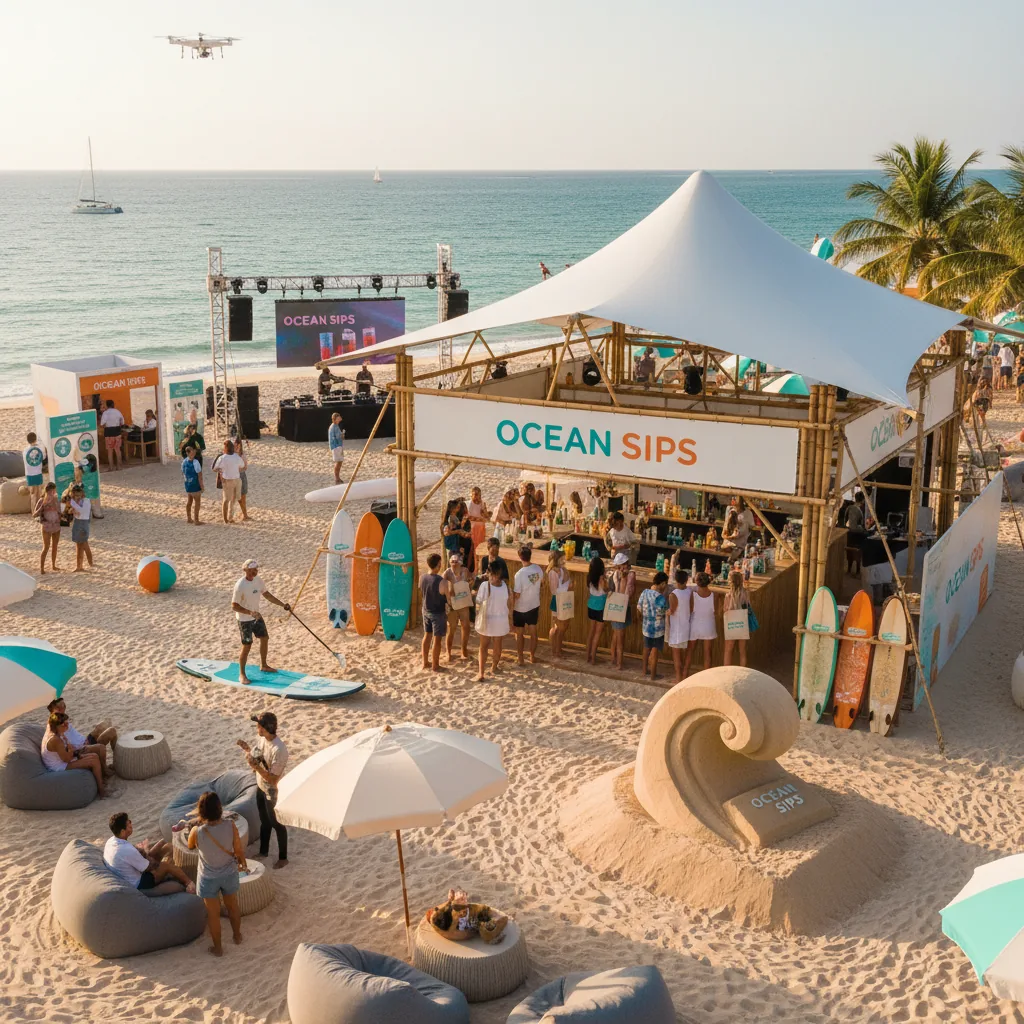
The mechanics are simple and easy to underestimate. Longer days mean more time spent outside of routines — commutes, offices, domestic loops — and in the spaces where brands have permission to show up differently: festivals, parks, beaches, high streets, terraces. People in those spaces aren't in task mode. They're receptive, social, and already looking for things worth sharing.
More importantly, the offline-to-online conversion rate improves dramatically. Something that catches someone's attention in a sunlit piazza has a far higher chance of becoming a social post than the same thing encountered in February. The combination of good light, good mood, and a phone always within reach means every physical brand moment has a digital second life if it's designed to.
The brands that understand this don't plan summer activations as a separate channel. They plan experiences that work in both registers simultaneously — worth being at and worth watching even if you weren't.
FMCG: owning the physical moment
Fast-moving consumer goods brands have always had a summer advantage: heat drives thirst, warmth drives occasion, and outdoor consumption is inherently visible. The smartest ones have learned to turn that visibility into content architecture.
Heineken's Clinker, Coachella 2026. This is the most interesting FMCG activation of the year so far. Heineken created a smart device that clips onto a beer can and syncs with the user's Spotify or YouTube Music data. When two Clinkers touch — when two people clink drinks — it lights up if their music tastes overlap, and then lets both users share their social handles through a web app to stay connected after the festival ends. The physical gesture of cheers becomes a music-matching, connection-making, share-worthy moment. The offline behaviour is ancient (raising a glass with a stranger); the digital layer on top of it is entirely new. The activation was grounded in research: 77% of music fans say they meet people at live events but rarely stay in touch. Heineken built the bridge between those two facts.
Aperol at Coachella 2024. Aperol has spent years building what is probably the most consistent summer brand world in FMCG. At Coachella, they created an Italian escape — cocktail-making stations, trivia, and spaces designed with photography in mind — that transported festival-goers into the brand's aesthetic before asking them to do anything. No purchase required, no hard pitch. Just immersion. The result was exactly what they designed for: attendees creating content that looked and felt like Aperol, sharing it organically, and doing the brand's social media work for free. The activation worked because Aperol's identity (European summer, golden hour, slowness) maps almost perfectly onto what festival-goers are already looking for. They didn't interrupt the mood; they deepened it.
Corona's Crusher programme. At beaches and outdoor festivals, Corona invited people to crush empty beer bottles into sustainable sand used in beach restoration. It's an activation that does three things simultaneously: creates something tactile and photogenic to share; reinforces Corona's environmental positioning; and gives participants a sense of contribution rather than just consumption. The sustainability layer matters increasingly: Deloitte research shows one in four Gen Z and Millennial consumers have reduced their relationship with a brand due to unsustainable practices. Letting people actively participate in the remedy, at the beach, in summer, while holding a beer, is as close to perfect alignment as FMCG gets.
Rhode's photo booth, Coachella 2024. Hailey Bieber's skincare brand offered festival-goers free lip tints in exchange for a moment in a branded photo booth. Simple, cheap, and extremely well-targeted — the outputs were immediately shareable, the product was literally in people's hands, and the format turned attendees into brand advocates before they'd walked ten steps from the booth. It's worth noting because it's one of the few examples where a relatively small brand (at the time) punched well above its weight at a major activation. Budget wasn't the constraint; targeting and format were.
Digital products: the counter-intuitive play
Digital brands have an instinct to retreat to the screen in summer — the audience is outside, so you push harder on social. The brands doing the most interesting work have inverted this. They go offline because their audience is offline, and use the physical presence to create a relationship that the product can continue in the app.
Spotify Beach, Cannes Lions 2024. Spotify took over a beach in Cannes for the duration of the festival. Artists performed. A "Jam Bike" let attendees pedal while contributing to a shared playlist. Industry sessions ran alongside entertainment. Every element was designed to create content: the performance, the playlist, the bike, the setting. Spotify didn't just show up at Cannes as a sponsor with a banner; they became the most talked-about space on the Croisette. The activation worked because it embodied exactly what Spotify is — discovery, shared taste, the social dimension of music — rather than just promoting the features. The product and the experience were the same thing.
Nike RunTown, London Marathon 2025. Ahead of the London Marathon, Nike opened a two-week pop-up on Regent Street that functioned as a genuine community hub: footwear trials, expert panels, personalisation stations, a collab apparel drop. It was technically a retail activation but it operated as a cultural moment for runners — a space worth travelling to, worth posting about, worth being part of. The underlying logic is one that Nike executes better than almost anyone: the brand isn't the product, it's the identity. RunTown gave London's running community a place to congregate and recognise themselves. Organic social did the rest.
Heineken's "Social Off Socials" summer campaign, 2025. Worth including here because it illustrates a different kind of digital-offline tension. Heineken built a campaign — featuring Joe Jonas and a cast of creators — around the idea of a world where social media goes quiet because everyone is out having a real life. The paradox (an anti-social-media campaign amplified by social media) is completely intentional. Heineken wasn't asking people to leave their phones at home; they were positioning themselves as the brand of real human connection, and using the platform they were ostensibly critiquing to spread that message. It's a sophisticated bit of brand architecture: the enemy of the product (mindless scrolling that kills real sociality) becomes the proof of the product's value.
The principles underneath the examples
Looking across these, a few things are consistent.
Design for the second audience. Every physical activation now has two audiences: the people who are there and the people who will see it on a screen later. The best summer activations are designed for both simultaneously. That usually means a visual centrepiece worth photographing, a mechanic worth explaining to someone who wasn't there, and a hashtag or share prompt that's so natural people use it without feeling prompted.
Map to what people are already trying to feel. Summer gives people permission to be more open, more social, more present. The activations that fail are the ones that interrupt that permission with a transaction. The ones that work amplify it — Aperol making the golden hour more golden, Corona making the beach feel worth protecting, Heineken turning a cheers into a connection. The brand's role is to deepen the experience the person is already having, not to redirect it.
The product is the proof, not the pitch. None of the strongest examples above spend much time explaining the product. Spotify didn't talk about its recommendation algorithm; they made it feel like a bike ride. Nike didn't sell running shoes; they built a community of people who run. When the activation embodies what the product does rather than describing it, trust transfers. That's the mechanism.
Give people a role, not an audience slot. The format that consistently drives UGC in summer is participatory, not spectatorial. Rhode's photo booth, the Jam Bike, the Clinker, the Corona Crusher — all of them invite action, not just observation. People share what they did, not just what they saw.
What this means for founders doing their own marketing
You don't need a Coachella budget or a Cannes beach. You need a mechanic that works at the scale you have.
A small brand can do a version of everything above: a pop-up at a local market designed to be photographed, a challenge tied to summer behaviour, a community event that gives a handful of people a role in something. The question to ask is not how big can we make this? but how shareable is the moment we're creating, and who will want to tell someone else about it?
Summer is temporary. That's the point. A window that opens in June and closes in September is a deadline, not a liability. The brands that move in it — with something physical, participatory, and designed for both the person standing in front of it and the one watching from a phone — are the ones with the content library and the community loyalty in September that everyone else is still trying to build.
Sofia Mello Barreto is a fractional CMO and GTM advisor working with pre-seed to Series A founders across Europe and the US. She specialises in brand positioning, GTM strategy, and AI-enabled marketing — particularly for founders building category-defining products without a full marketing team. If this resonated, the best place to start is a conversation: calendly.com/sofiademb/meeting-sofia